USP 795 vs. 797: What Sterile Compounding Standards Mean for Patients and Providers


You've probably seen "USP 797 compliant" on a compounding pharmacy's website. Maybe your prescriber mentioned it. Maybe you noticed it on ours. Either way, it's worth knowing what it actually means — because when it comes to a medication going into your patient's eye, vein, or joint, "we follow USP 797" isn't a marketing line. It's the baseline for safety.
USP standards are the national benchmarks for compounded medication quality and safety in the United States. They define what a pharmacy must do — in terms of facilities, processes, testing, and training — to prepare compounded medications responsibly. This article breaks down what USP 795 and USP 797 cover, how they differ, what real compliance looks like inside a pharmacy, and why it matters when you're choosing a compounding partner for your patients or yourself.
What Is USP Compounding?
The United States Pharmacopeia (USP) is a nonprofit scientific organization that sets quality standards for medications, dietary supplements, and food ingredients in the U.S. For compounded medications specifically, USP publishes a set of enforceable chapters that define how preparations must be made, tested, labeled, and stored.
Because compounded medications are prepared patient-by-patient from raw or bulk pharmaceutical ingredients — rather than manufactured at scale under FDA oversight — they require their own standards framework. USP chapters 795 and 797 are the two primary chapters governing compounding practice. For accredited pharmacies, these aren't optional guidance documents. They're the standard of practice.
USP Chapter 795 — Nonsterile Compounding
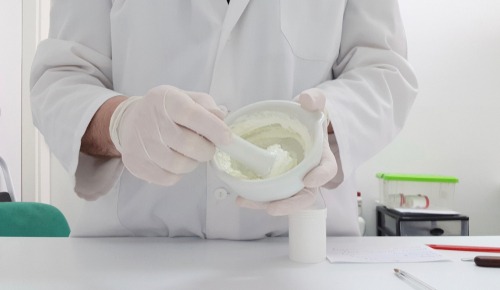
USP Chapter 795 governs the preparation of nonsterile compounded medications — formulations that are applied to the skin, taken orally, or administered in ways that don't bypass the body's natural defenses.
Common USP 795 preparations include:
- Oral liquids and suspensions
- Topical creams, gels, and ointments
- Capsules and troches
- Suppositories
USP 795 sets requirements for ingredient quality, compounding facility conditions, documentation, labeling, and beyond-use dating (BUD) — the date after which a preparation should not be used. The standard is rigorous, but the contamination risk profile for nonsterile preparations is meaningfully different from sterile ones, which is why USP 797 exists as a separate, higher-stakes chapter.
If your provider has prescribed a custom topical pain cream, a compounded hormone troche, or a pediatric oral suspension, that preparation falls under USP 795.
USP Chapter 797 — Sterile Compounding
USP Chapter 797 governs sterile compounded preparations — any formulation that bypasses the body's natural defenses and is introduced directly into the body. That includes:
- Injectable medications (subcutaneous, intramuscular, intravenous)
- Ophthalmic (eye) drops and ointments
- Inhalation solutions
- IV preparations and infusions
The stakes for sterile compounding are categorically different from nonsterile. A contaminated topical cream is a serious problem. A contaminated injectable can cause infection, serious harm, or death. USP 797 exists because the margin for error in sterile preparation is essentially zero.
Key USP 797 requirements include:
- ISO-classified cleanrooms: Sterile preparations must be compounded in controlled environments with defined air quality standards — typically ISO 5 primary engineering controls (like laminar airflow hoods or isolators) within ISO 7 or ISO 8 classified rooms.
- Aseptic technique: Every step of the compounding process must minimize contamination risk.
- Environmental monitoring: Ongoing air and surface sampling to verify that cleanroom conditions remain within specification.
- Personnel training and competency: Pharmacists and technicians must demonstrate proficiency — including media fill testing and gloved fingertip sampling — before compounding sterile preparations.
- Beyond-use dating: USP 797 defines specific BUD limits for sterile preparations based on conditions, sterility testing, and storage.
The 2023 USP 797 Updates
The most recent revision to USP 797 took effect in November 2023. The updated chapter tightened BUD assignments, introduced clearer category definitions for sterile preparations, and added more explicit requirements for personnel training, environmental monitoring, and quality oversight. Pharmacies that were already operating to a high standard — with PCAB accreditation and rigorous internal processes — largely absorbed these changes without major disruption. Pharmacies that were doing the minimum had to catch up.
USP 795 vs. 797 — What's the Difference?
The short answer: route of administration and contamination risk determine which standard applies.
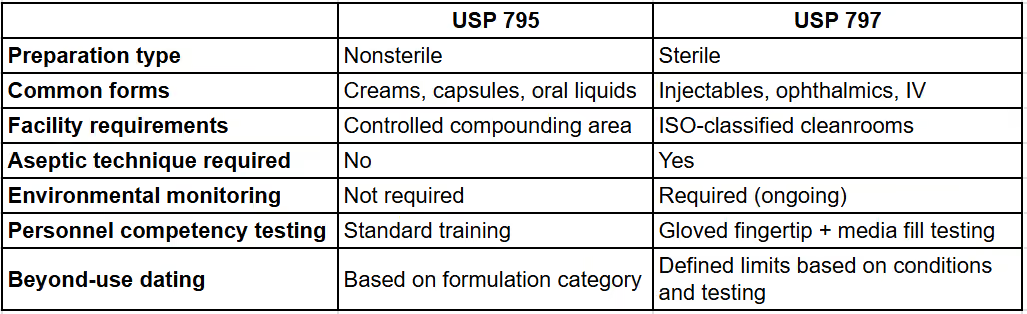
A single pharmacy may operate under both chapters — and a robust compounding pharmacy
typically does. When your patient needs a compounded testosterone injectable, that's USP 797 territory. When they need a custom topical for a dermatological condition, that's USP 795. The pharmacy needs to be equipped and qualified for both.
What Does "Aseptic Technique" Actually Mean?
Aseptic technique refers to the set of practices used during sterile compounding to prevent microbial and particulate contamination. In plain terms: it's how a pharmacist or technician handles a sterile preparation without introducing anything that shouldn't be there.
In practice, aseptic technique includes:
- Proper gowning: Sterile gloves, gown, mask, hair and shoe covers — because human skin and hair are contamination sources
- Cleanroom discipline: Defined entry/exit procedures, no unauthorized materials, limited personnel movement
- Laminar airflow hoods or isolators: These devices create a continuous stream of HEPA-filtered air over the compounding work surface, creating a "first air" zone that's essentially particle-free
- Validated hand hygiene and surface disinfection protocols
Aseptic technique isn't one thing you do — it's every step, done correctly, every time. It requires training, demonstrated competency, and a culture of getting it right even when no one's watching. That's part of why USP 797 requires documented competency testing, not just training completion.
PCAB Accreditation and USP Compliance — What the Connection Means
PCAB — the Pharmacy Compounding Accreditation Board — is the gold-standard, third-party accreditation body for compounding pharmacies in the United States. Earning PCAB accreditation requires a pharmacy to demonstrate documented compliance with USP 795 and 797, among other quality standards. PCAB auditors conduct on-site inspections and review policies, procedures, testing records, and facilities.
What this means in practice: when a pharmacy carries PCAB accreditation, a credentialed outside body has reviewed their operations and verified that they meet the national standards for compounding safety and quality — not just on paper, but in the cleanroom.
For prescribing providers, this matters. You're not taking the pharmacy's word for it. You're working with a pharmacy that has been audited and has earned that credential.
The Chemist Shop is PCAB-accredited and ACHC-accredited, with sterile compounding prepared in-house in a USP 797-compliant facility. That's the infrastructure behind every sterile preparation we dispense.
Why USP Compliance Matters When Choosing a Compounding Pharmacy

Not every pharmacy that calls itself a compounding pharmacy is equipped for sterile compounding. And not every pharmacy that performs sterile compounding does so to the same standard.
Questions worth asking a compounding pharmacy:
- Are you PCAB accredited?
- Do you have an ISO-classified cleanroom for sterile preparations?
- How do you handle environmental monitoring and beyond-use dating?
- Are your pharmacists and technicians competency-tested for aseptic technique?
- What quality testing do you perform on sterile preparations?
If a pharmacy can't answer those questions clearly — or deflects — that's a red flag. A pharmacy operating a genuine USP 797-compliant sterile compounding program should be able to walk you through their facility and processes without hesitation.
The difference between a USP-compliant sterile compounding pharmacy and one that isn't isn't a matter of paperwork. It's a matter of whether the medication your patient is injecting was prepared in a controlled, verified, contamination-minimized environment — or not.
Frequently Asked Questions
What is the difference between USP 795 and USP 797?
USP 795 covers nonsterile compounded preparations — topicals, oral liquids, capsules — and sets standards for ingredient quality, facilities, and beyond-use dating. USP 797 covers sterile preparations such as injectables and ophthalmic drops, where contamination risk is significantly higher, and requires ISO-classified cleanrooms, aseptic technique, environmental monitoring, and personnel competency testing. Both chapters apply to accredited compounding pharmacies, depending on the types of preparations they produce.
Does PCAB accreditation mean a pharmacy follows USP 797?
Yes. PCAB accreditation requires demonstrated compliance with USP 795 and USP 797 as applicable to the pharmacy's scope of practice. If a PCAB-accredited pharmacy performs sterile compounding, they have been evaluated for USP 797 compliance by third-party auditors. Accreditation is not self-reported — it requires an on-site review and ongoing compliance.
Are compounded medications FDA-approved?
No. Compounded medications are not FDA-approved. They are prepared by a licensed pharmacist pursuant to a valid prescription from a licensed prescriber, customized to meet a specific patient's needs when a commercially available medication does not meet those needs — as determined by their provider. Compounded medications prepared at a 503A pharmacy are patient-specific preparations, not manufactured drug products.
How do I know if my compounding pharmacy is USP 797 compliant?
Ask directly. A USP 797-compliant sterile compounding pharmacy should be able to confirm that they operate an ISO-classified cleanroom, follow documented aseptic compounding procedures, conduct ongoing environmental monitoring, and have personnel who are competency-tested. PCAB or ACHC accreditation provides third-party verification of these standards. You can also verify accreditation status directly through the PCAB or ACHC directories.
What is a beyond-use date for compounded medications?
A beyond-use date (BUD) is the date after which a compounded preparation should not be used. Unlike a manufacturer's expiration date, which is based on stability data for mass-produced products, a BUD for a compounded preparation is assigned based on USP chapter requirements, formulation conditions, storage environment, and — for sterile preparations — whether sterility testing has been performed. BUD requirements differ between USP 795 and USP 797 and are a key component of compounding pharmacy compliance.
The Bottom Line
USP compliance isn't a badge on a website. It's what determines whether a sterile compounded medication was prepared in a controlled, verified, contamination-minimized environment — or not. For patients and providers making decisions about compounded medications, that distinction matters.
If you're a provider evaluating a compounding partner, we'd welcome the conversation. The Chemist Shop is PCAB-accredited, sterile-capable, and built for providers who expect more from their pharmacy. Contact us to learn more about partnering with us.
If you're a patient with questions about your compounded prescription, reach out to us directly or ask your provider about The Chemist Shop.
This article is for informational and educational purposes only and does not constitute medical advice. Compounded medications are prepared pursuant to a valid prescription from a licensed healthcare provider and are not FDA-approved. Patients should consult their healthcare provider regarding any medication decisions.