
Opthalmology

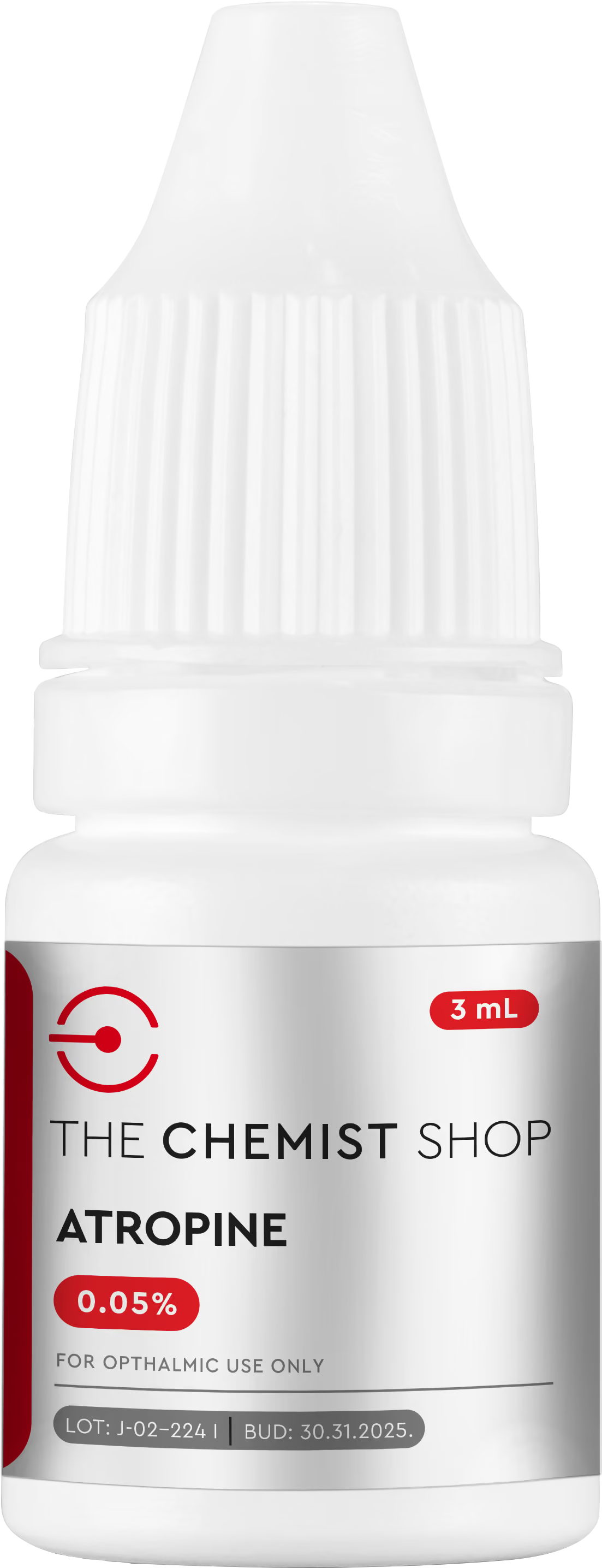
Atropine Eyedrops

Used off-label to slow the progression of myopia (nearsightedness) in children and adolescents, generally between ages 5 and 15. Standard commercial atropine ophthalmic solutions are formulated at 1% — far too concentrated for myopia control

Dosage Form:
Solution
Search for a Provider
Buy Now Pay Later

Pay in installments with 0% interest and no extra charges through Shop Pay

Easy Returns

Your exchange ships out as soon as you email us. Save 15% monthly delivery

Wordwide shipping

Receive your order an estimated 3-5 days after shipment
How it works

Atropine is a non-selective muscarinic acetylcholine receptor antagonist. While the precise mechanism of myopia control is not fully established, the leading hypothesis is that atropine acts on muscarinic receptors in the retina and sclera (not primarily through accommodation, as once thought) to slow axial elongation of the eye, which is the underlying anatomical driver of progressive myopia. Low concentrations are used to minimize the pupillary dilation (mydriasis) and loss of near focus (cycloplegia) seen at higher strengths, while still producing a measurable reduction in myopia progression.

Side Effects

Generally well tolerated at low concentrations. The most common effects are mild and dose-dependent: light sensitivity (photophobia), slight pupil enlargement, mild blurring of near vision, transient stinging on instillation, and local allergic reactions or contact dermatitis on the eyelid. Side effects are more pronounced at 0.05% than at 0.01%. Rare systemic anticholinergic effects (dry mouth, flushing, tachycardia, headache) are possible if absorbed in larger amounts, particularly in very young or small children.

Storage

Store in a refrigerator (36-46°F). Do not freeze. If needed, it can be kept at room temperature for up to 24 hours.

Pregnancy Information

Not indicated for use during pregnancy.

Drug Interactions

Minimal at low ophthalmic doses due to limited systemic absorption. Theoretical additive anticholinergic effects with other antimuscarinic agents (e.g., tricyclic antidepressants, antihistamines, certain antipsychotics, antispasmodics). Use caution in patients with Down syndrome, primary angle-closure glaucoma risk, or known atropine hypersensitivity.

Medicine made for the person taking it

Partner with us, or find a provider who prescribes through The Chemist Shop.

Find a provider

Lorem ipsum dolor sit amet, consectetur adipiscing elit, sed do eiusmod tempor incididunt ut labore et dolore magna aliqua

Thank you! Your submission has been received!
Oops! Something went wrong while submitting the form.